Showing posts with label vice presidential flashcards. Show all posts

Friday, May 16, 2014

Elbridge Gerry: Salamanderian Vice President

What are you gonna do about it, motherfucker?
At long last, it's time for another vice presidential post, friends! I picked this guy because he has a funny-looking name. Elbridge Thomas Gerry (pronounced like "Gary") was born in Massachusetts in 1744 to a family of merchants. If you were like, "WTF kind of name is Elbridge?" I will tell you! It's one of his maternal ancestors' last names or whatever. Elbie was the third of eleven children in the Gerry family, only five of whom survived to adulthood because old-timey times. He studied with tutors from a young age and went to Harvard at 14, where he would eventually earn bachelor's and a master's degree in somethingorather. In the 1760s, Gerry joined his father's business and made some $$. Or at least my notes just say "$$" right there, so I'm going to assume that's what that was supposed to mean. Elbridge's dad was involved in the local militia and politics. Presumably those contacts were useful to Elbridge as he took an interest in politics himself. He was against Parliament taxing the colonies and was in correspondence with Samuel and John Adams about such issues.

THERE HE IS!
The 'Bridge got himself elected to some kind of provincial legislature, worked with his pal Sam Adams, something something a committee of correspondence and a riot over smallpox inoculations. He did some other shit, but refused a seat at the First Continental Congress because his father had recently died and he needed to stick close to home. Back in the provincial assembly, Gerry used his foreign business contacts to support the new Continental Army. He did attend the Second Continental Congress, supported the passage of the Declaration of Independence, and was one of its signatories. Good job, Elbridge Gerry, that is an important document! He didn't want too much power centralized in the federal government, got in a bit of a snit about it, and resigned from the congress over it. He came back to the epically useless Confederation Congress in 1783, though. He couldn't quit you, fledgling United States government!

In 1786, Gerry married Ann Thompson, the (much-younger) daughter of a merchant. James Monroe was his best man. They had ten kids in fourteen years, to which my mother would (awkwardly) say, "You guys need to get cable." All that old timey child-bearin' pretty much destroyed Ann's health. Nice job, Elbbzz. But enough about his dick. Gerry made money during the Revolutionary War, after which he sold his business(es?) and invested in land, including Elmwood Estate, which would become the family compound or something. In 1787, Gerry served as a representative to the Constitutional Convention in Philadelphia. He was against the 3/5 Compromise and the popular election of Senators. Mixed bag on that one. He actually spoke out against ratification because he believe the Constitution needed to list citizens' personal liberties and refused to sign the document. At some point during state ratification proceedings, Gerry got into a shouting match with another representative and got thrown out. Pretty badass.

"SRSLY, you're not going to include a bill of rights?"
With fellow dissenters George Mason and Edmund Randolph at the National Constitution Center.** Source.
Gerry was nominated as an Anti-Federalist candidate for Governor of Massachusetts in 1788, but was defeated by one big-signatured fellow by the name of John Hancock. Gerry did, however, get nominated and actually served two terms in the very first sessions of the U.S. House of Representatives. From the House, he helped shape the Bill of Rights. He was big on the Second Amendment, the militia-having part, because he was nervous about standing armies. He may or may not have* accused such an institution as being dangerously similar to a "standing member," which shows you that the right to bear arms has always been about penises. Gerry was a supporter of Alexander Hamilton, who, as we know, is on the ten (What have you done?).

In 1792, Gerry decided to take a break from politics to go home to Massachusetts and take care of his approximately 134 children and ailing wife. He did serve as a presidential elector for his old colleague John Adams in 1796 and stayed strategically friendly with both Adams and Jefferson. In 1797, Adams sent Gerry to France as part of a diplomatic mission to Talleyrand. THIS TRIP DID NOT GO WELL (See: XYZ Affair). Gerry was temporarily tarnished by the whole debacle. In 1800, Gerry officially joined the Democratic-Republican Party, but he couldn't get elected to governor of Massachusetts (again) and went back into semi-retirement since by now his brother had somehow managed to fuck up the whole family's finances.

If anything, that's like, a dragon or some shit.
Gerry was finally elected the state's governor in 1810, despite claims that he was a "French partizan." Things got dicey in 1812 when the Republican-controlled state legislature redrew districts to benefit its own party. Detractors (who are bad at animals) claimed the boundaries of one district were so nonsensical and partisan, that it resembled a salamander, attributed the scandal to the leader of the state's party, and the word "Gerrymander" was born. Over time the voiced velar stop (/g/) of Gerry's last name shifted to a voiced alveo-palatal affricate (/dʒ/) in the portmanteau's pronunciation. That's some Parks & Rec shit. Also there was that whole "War of 1812" situation heating up, Governor Gerry tried to sue some Federalist newspapers for libel, and he lost reelection in 1812, though his compatriots in the legislature gained from their own line-drawing and recaptured majorities.

At this time, because of his shattered finances, Gerry asked President James Madison for a federal position to help support his family. He was chosen as Madison's running mate for the 1812 election, though he really was second choice. Gerry was considered a safe choice for vice president because he would appeal to Northern voters and would not threaten Monroe's position as Madison's heir apparent. Of course, Madison and Gerry were elected, and Elbridge spent his short term in office worrying about Federalist newspapers and pulling partisan moves during the War of 1812. Unfortunately, while working at the Capitol one day in 1814, Gerry suddenly fell ill and died that night. His sickly wife outlived him. He had paid off his brother's debts with his VP salary, so he was only able to leave his family the land they owned. Gerry was interred in Washington, D.C. and is the only signer of the Declaration to be buried in the District. One of his sons and a grandson would ultimately serve in Congress, but Gerry's greatest legacy is being the eponym for a shady election tactic.

*Too lazy to verify if this quote is real.
**Guys, Aimee Mann and Ted Leo (The Both) tell a great story about when they played Aimee's "Save Me" for some awards ceremony for Hillary Clinton at the National Constitution Center WHICH IS WHERE THESE STATUES ARE FROM. Why aren't you listening to The Both by The Both right now on repeat like I have been for a couple of weeks? We saw them last weekend here in Minneapolis and I'm not saying that I want to join them in a non-platonic musical/comedy trio or anything, but I'm not not saying that, either.

Wednesday, October 02, 2013

Vice Presidential Blogging: Schuyler Colfax

That's a pretty good beard.
America's Most Seventeenth Vice President, one Schuyler Colfax, Jr., was born in New York City in 1823. In old-timey disease tragedy news, Colfax, Sr. died of tuberculosis before Baby Skysky was born to his wife Hannah. Apparently Colfax came from distinguished stock as his grandfather was a bodyguard of some kind to GWash during the Revolutionary War. Growing up, Schuyler lived with his mother and grandmother, who ran a boarding house. He ended his formal education at age ten to start working, just like today's Republicans advise to avoid getting all childhood-obese. When Schuyler was thirteen,which is officially the worst age anybody can be,* Hannah remarried and the family moved to Indiana. Young Schuyler was interested in politics and as a teenager wrote articles, advocated for the Whig Party, and became friends with Horace Greeley--who contrary to popular belief, was a famous abolitionist and newspaperman, not a professional Benjamin Franklin impersonator.

Greeley could've been raking it in.
Anyway, Colfax became editor of the South Bend, IN Free Press at age nineteen, and bought the paper within a few years, renaming it the St. Joseph Valley Register. Fancy that! He married childhood friend Evelyn Clark in 1844. They had no children when she died in 1863. He dived into actual politicking in 1848, as a Whig Party convention delegate. He also participated in the 1849 Indiana State Constitutional Convention. He ran for Congress for the first time in 1850 and lost. But! He picked himself up and was elected to the House in 1854 as an Anti-Nebraska candidate (he was against the Kansas-Nebraska Act). In that downtime, Colfax become one of the founders of the Rebekah Degree (basically the lady branch of the Odd Fellows). You know who was a Daughter of Rebekah? Eleanor Roosevelt! Our lesbianest First Lady (until Hillary Clinton, amirite?)! As an anti-slavery politician, Colfax found his way to the Republican Party after the Whigs collapsed, serving several more terms in Congress. He served as the Speaker of the House 1863-69, though I'm pretty sure you didn't have to be an Orange-American to achieve that position back then. As Speaker, Colfax announced the passage of the Thirteenth Amendment to the Constitution, which outlawed slavery. Huzzah!


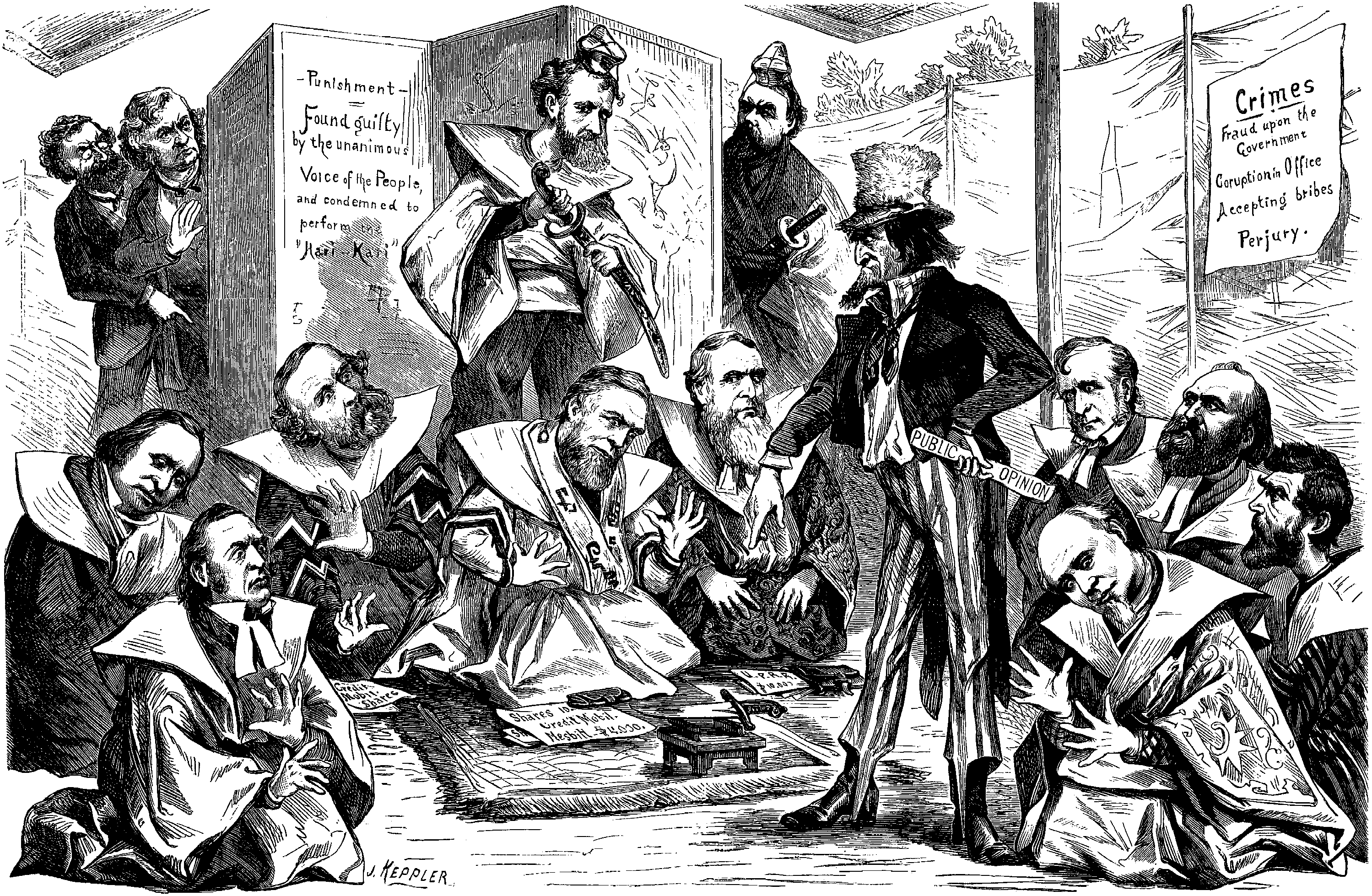
Colfax got recruited to run as Ulysses S. Grant's veep in 1868. Two weeks after the election, he was remarried to one Ella Wade (some Senator-or-rather's niece), with whom he had his son Schuyler Colfax, III, because who could let a legacy name like that die out? As far as I know, he did nothing of note as VP. Unfortunately (fortunately?), during his time in the House, Colfax and pretty much every other Congressman took money from those shady grafters at the Union Pacific Railroad. He was implicated in the Crédit Mobilier Scandal in 1872, and was replaced by Henry Wilson** as VP on Grant's reelection ticket in 1872. What is the deal with the Crédit Mobilier scandal, you might ask? Well, so you don't have to read the whole Wikipedia article, I will summarize (probably pretty inaccurately):

So, like, in the mid-1860s, the U.S. government thought it might be a good idea to set up a transcontinental railroad and chartered the Union Pacific Railroad to make it happen. High-ranking Union Pacific officials were skeptical that they could ever make money off of running a railroad, so they hatched a nefarious plan: they secretly set up "Crédit Mobilier of America," a supposedly independent construction company they were contracting to do the actual railroad-building work. However, it was basically a sham company set up to line the pockets of railroad tycoon types. How it worked was through a system of indirect billing and blatant fraud: "Crédit Mobilier" would invoice Union Pacific for construction costs, who would in turn invoice the federal government the same amount plus "overhead" costs. But since Crédit Mobilier was Union Pacific, there were no overhead costs, and the extra government cash went to the secret shareholders AKA Union Pacific's executive fat cats. Congress got tangled up because Congressman Oakes Ames was set up as head of Crédit Mobilier in 1867. He used his political influence to sell his fellow Congressmen Crédit Mobilier stocks at discount rates, in addition to blatant gifts and bribes to keep Congress from auditing the whole shady business. Whether Colfax or most of his colleagues were really aware of the larger scam is unclear, but this is just your hourly reminder that corporate sponsorship of Congress is not exactly news.

I believe that's Colfax front and center and Uncle Sam wants all these congressdudes to commit hari-kari for ripping off the government. Or something. (Source)
But anyway, Grant dumped Colfax. After he left political life, Colfax was a successful lecturer. Gotta replenish the 'ol coffers! In a tragically hilarious turn of events, he was basically killed by the Minnesota winter. He's buried in South Bend, IN and numerous towns across the U.S. of A. are named for him. His grandparents' home in Wayne, NJ, the Schuyler-Colfax House, originally erected in 1695, is a museum currently owned by the Wayne Township. So that's a thing. Also, Bill Raymond plays Colfax in the recent movie Lincoln, which I saw and had opinions about here.


*Until they are nineteen and in college and think they are some hot shit, that is.
**Though Wilson also took money in the scandal, I guess? Somehow James A. Garfield, also implicated in the scandal, wormed his way out of it well enough to be elected president in 1880.

Tuesday, August 06, 2013

VP Blogging: Alben W. Barkley

Have you been helplessly pressing refresh on your Google Reader Feedly or browser window or whatever, hoping beyond hope that I might one day return to the glory days of this blog, back in, like, 2008 when I'd post weekly presidential profile write-ups? WELL NOW IT IS HAPPENING. Though I'm pretty much out of presidents, so Imma do vice presidents. This particular VP was part of a pub trivia question a while back and I was ashamed of myself for not knowing who he was. Now I know and now also you will know.

Oh, look at me, President Truman's giving me some fancy Congressional service gold medal.
Alben W. Barkley was Harry S. Truman*'s second in command (1949-1953), but that was but a small moment in a long and incredibly industrious political career. Also, we recently watched season one of Veep. It is amazing. TRUE FACT: it was Barkley's grandson who coined the nickname "Veep" for his grandfather while he was serving as vice president. Apparently the next veep, Richard Nixon, was not so into it, but it is still around! But anywaaays, Barkley was born in 1877 as "Willie Alben Barkley," but he was not into that name, so he switched that shit around as soon as he could. He was the oldest of eight children born to tobacco tenant farmers in Kentucky. His paternal grandmother was a midwife who delivered him in a fucking log cabin OMG badass. Barkley's father was a Presbyterian elder who did not approve of alcohol or playing cards or any of that sinful frippery. Alben and his siblings, when not working on the family farm, stayed with their grandparents a lot. Presumably in said log cabin house thing.

Barkley briefly enrolled in a seminary, but then was like, "No thanks, Jesus," and got a scholarship and a job as a janitor at Marvin College in Clinton, Kentucky. There he did debating and fraternity-ing and whatnot and also became a Methodist. He moved on to Emory College (now University) in Georgia for grad school or something, but was too poor to keep it up. He taught back at Marvin for awhile, but that wouldn't pay his bills either. He got jobs with congressmen and lawyers, whose books he used to read the law. He passed the bar and then went to UVA Law School for a bit, because I guess that's how that worked around the turn of the century. In 1903 he married Dorothy Brower, with whom he would have three children. In addition to having babies and becoming a lawyer Barkley was a lay preacher and member of numerous fraternal organizations, including the Improved Order of Red Men, which doesn't sound racist at all.

Barkley identified as a Democrat early on, but one who was for sticking to the gold standard (a very controversial and boring issue at this time, if you will recall from those chapters in your history textbook you skimmed over between the Civil War and WWI). In 1905, Barkley was elected to his first office: county attorney, moving up to county judge three years later. He was known for rooting out financial corruption in government. In 1912, he ran for Congress. More conservative Democratic opponents called him a socialist for supporting federal funding of highway construction, but he was ushered into office on Woodrow Wilson's progressive coattails. During this time, Barkley stuck closely to his religious, teetotaling roots (BORING) and spoke for the Anti-Saloon League as well as sponsoring bills to ban the sale of alcohol in D.C. Though he initially endorsed American neutrality during World War I, he supported Wilson and the war effort upon the U.S.'s entry in 1917. He was also a supporter of the ill-fated League of Nations.

Proof he was not always an old man.**
Flash forward all the way to 1923, when Barkley ran for governor of Kentucky. He lost in the Democratic primary but first earned his nickname "Iron Horse" for his marathon campaigning--giving up to sixteen speeches a day while on the trail. He picked himself up and in 1926 was elected to the U.S. Senate for Kentucky. He was even considered as a running mate for Al Smith's unsuccessful presidential run in 1928. Barkley spoke out against our hapless friend Herbert Hoover's handling of the Great Depression and was the keynote speaker at the 1932 Democratic National Convention that nominated Franklin Roosevelt. Apparently he nearly caused a riot on the convention floor when he suggested the party adopt a platform plank repealing Prohibition. Not that he was, like, suddenly all about the boozing, but because he believed it was the will of the people. Of course, FDR swept into office with majorities in both legislative bodies, and as Senate Majority Leader, Barkley was a huge supporter of New Deal reforms. He gave the keynote again at the 1936 DNC which of course renominated President Roosevelt, but a divided caucus in the Senate halted further reforms, leading to a new nickname for the leader: "bumbling Barkley." In his 1938 reelection bid, the bumbler was challenged in the primary by one Governor "Happy" Chandler, a more conservative Dem who at one point accused Barkley's campaign of poisoning his ice water. OBVS. FDR endorsed Barkley without actually endorsing him, and he once again won the party nomination and recaptured his Senate seat.

Though passed over as VP once again in favor of awesomely communist John Nance Garner in 1940, Barkley continued to support FDR in the Senate what with the declaration of war and whatnot, though apparently was insulted when not offered an open seat on the Supreme Court. Some shenanigans that are boring involving some kind of revenue bill ultimately broke the alliance between Barkley and Roosevelt, and Truman was chosen as FDR's fourth term running mate instead. Barkley supported the U.S.'s involvement in the U.N. and was instrumental in the development of the coordinated Department of Defense after heading up a congressional investigation of the Pearl Harbor attack. Unfortunately, Barkley's wife Dorothy fell into ill health. She had heart problems and Barkley went on the speaking circuit while Congress was out of session to help pay their many medical bills. They even sold their house and moved into an apartment to save money, but she died in 1947. A Republican resurgence in the midterm elections of 1946 didn't help the situation in Congress, but Barkley was eventually asked to keynote the DNC once again in 1948, and though Truman's second choice, became the vice presidential candidate.

Stone-cold getting remarried while VP. St. Louis Post-Dispatch
As Vice President, Barkley supported Truman on civil rights reforms, attended Cabinet meetings, and regularly presided over the Senate. But mostly VPs don't really do much. While America's #2, Barkley met a special lady named Jane Hadley, many years his junior, whom he married in November of 1949.  He unofficially entered the 1952 Democratic primary, but people were like, "Oh, he's super-old and has heart problems and failing eyesight" and Barkley ended up withdrawing his name before the convention, where Adlai E. Stevenson, perpetual crossword puzzle answer, was ultimately nominated. After a short break from politics, Barkley actually ran again for Senate for Kentucky in 1954 and was elected. Kind of like when John Quincy Adams went back to the House after his presidency, you guys! He insisted on sitting in the back of the Senate Chamber with the other freshman senators since his previous seniority apparently no longer applied. He wasn't in the Senate long, however, when he collapsed on stage during a speech and died of a heart attack in 1956. He's buried in Paducah, where a bunch of shit is named for him. Alben W. Barkley, guy who did lots of politics for, like, half the twentieth century, huzzah!


*I think I have somehow missed writing up Harry Truman. HOW IS THIS POSSIBLE?!
**Though he does look kind of cuddly and avuncular as an old man.